EV Roaming Clearing House: One Counterparty Instead of Fifty
By YoHub10 min read

💡 EV Roaming Clearing House: Summary
- Bilateral settlement multiplies work. A CPO roaming with 50 eMSPs runs 50 reconciliations, 50 invoices, 50 collection cycles and 50 dispute queues: about 200 money workflows a month.
- Across 70+ CPO networks and 40+ eMSPs, pairwise settlement could mean up to 2,800 relationships. A clearing house needs one per party, about 110.
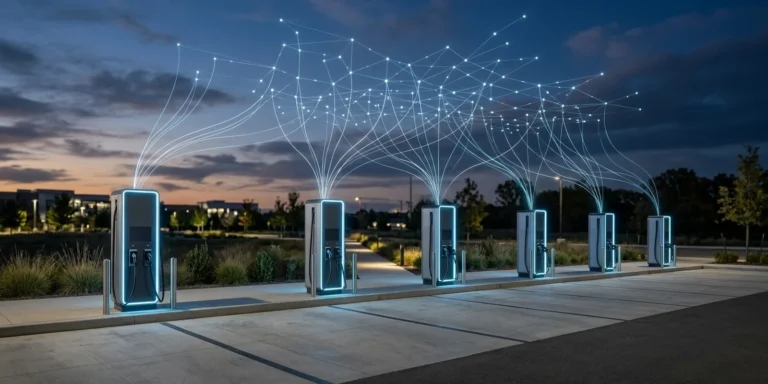
- An EV roaming clearing house reconciles kWh and amounts on both sides against each contract, then invoices, collects and pays out, so each party has one counterparty.
- The hub settles money in India only. Outside India it reconciles kWh and amounts, and the parties settle directly with each other.
- The CDR stays the unit of account. OCPI 2.2.1 CDRs cannot be edited once sent, so every correction is a Credit CDR, handled in one queue instead of fifty.
An EV roaming clearing house solves a problem most CPOs only notice at month-end. Connecting to another eMSP is an integration task. Getting paid by each of them is an accounting task, and it grows with every partner. Roam with 50 eMSPs and you do not have one roaming revenue line. You have 50 small ones, each with its own reconciliation, invoice, payment terms and dispute queue.
This post is for CPO finance and operations heads, and for eMSP business teams who carry the same load from the other side. It shows why bilateral settlement scales badly, how a clearing house runs reconciliation, invoicing and settlement step by step, and where the model differs between India and other markets. The engineering cost of point-to-point links is a separate question, covered in OCPI bilateral connections.
The arithmetic of bilateral roaming settlement
Take a CPO that roams with 50 eMSPs. The number is an illustration, not a count of any real network, but a mid-sized operator gets there quickly once it opens up to driver apps, fleet platforms and payment apps. In a bilateral model, every month it has to:
- Reconcile its charge detail records (CDRs) against 50 sets of eMSP records, each in that partner’s format.
- Invoice 50 partners, each invoice carrying its own tax treatment and, in India, its own GST e-invoice.
- Collect across 50 payment cycles on 50 sets of payment terms.
- Resolve disputes in 50 separate queues, each with its own contact, evidence format and deadline.
That is about 200 money workflows a month, or 2,400 a year, before a single new partner is added. Each eMSP carries the mirror image: it reconciles against, receives invoices from and pays every CPO its drivers use.
The network view is worse. If C CPOs and E eMSPs all settle pairwise, the number of settlement relationships can reach C × E. On the YoHub network, with 70+ CPO networks and 40+ eMSPs as of October 2026, that is up to 2,800 pairwise relationships if every pair roamed directly. Through a clearing house each party holds one settlement relationship, about 110 in total. Not every pair would roam, so 2,800 is a ceiling rather than a count. The point is the shape: pairwise work grows by multiplication, clearing-house work grows by addition.
| eMSP partners | Bilateral workflows a month | Through a clearing house (India) |
|---|---|---|
| 5 | 20 | 4, against one counterparty |
| 20 | 80 | 4, against one counterparty |
| 50 | 200 | 4, against one counterparty |
Monthly settlement workflows for one CPO (reconciliation, invoicing, collection, disputes). Illustrative. Outside India, reconciliation is centralised but invoicing and collection stay with each partner.
Where the month-end effort goes
The four workflows look simple on a slide. Each one has its own trap, and each trap repeats once per partner.
Reconciliation
Every roamed session ends as a CDR, which the OCPI 2.2.1 CDRs module calls the only billing-relevant object. The CPO sends it and the eMSP checks it against its own session and token records. Records disagree for predictable reasons: missing or duplicate CDRs, Wh-versus-kWh errors, sessions that cross midnight, tariff versions that changed mid-session. The full taxonomy is in CDR reconciliation. Bilaterally, each partner reconciles in its own format and on its own schedule, so the same error gets found, argued and fixed 50 different ways.
Invoicing and tax
Each partner needs its own compliant invoice. In India, public EV charging is taxed as a service at 18% GST (Business Today, September 2024), and any business whose aggregate turnover has crossed ₹5 crore in a financial year since 2017-18 has had to issue GST e-invoices since 1 August 2023 (Notification 10/2023-Central Tax). In the UAE, mandatory B2B e-invoicing starts on 1 January 2027 for businesses with revenue of AED 50 million or more, and on 1 July 2027 for the rest (KPMG). Fifty partners means fifty compliant invoices every period, each tied to a reconciled number.
Collection and credit exposure
Bilateral roaming is trade credit. The CPO delivers energy all month, invoices after month-end, then waits out the payment terms. With monthly billing and 30-day terms, the oldest session on an invoice can be about two months old when the money arrives. That exposure sits with 50 counterparties of very different sizes, from funded apps to small fleet platforms, and chasing them becomes a credit-control job of its own.
Disputes
OCPI does not let a CPO edit a CDR once it is sent. A correction is a Credit CDR: a new record with credit set to true, a credit_reference_id pointing at the original, and negated cost totals, followed by a fresh CDR if needed. The spec leaves the time allowed for credits to the business contract, so 50 partners can mean 50 different dispute windows.
How an EV roaming clearing house works, step by step
A clearing house changes who each party deals with, not the OCPI data. Sessions, tokens, tariffs and CDRs are the same objects. What changes is that one party reconciles all of them and stands in the middle of the commercial flow.
| Step | What happens | What the parties see |
|---|---|---|
| 1. Exchange | Sessions and CDRs flow through the hub. OCPI 2.2.1 message routing carries the sender and receiver party IDs, so each record reaches the right partner. | The CPO sends each CDR once, to one destination. |
| 2. kWh reconciliation | The hub matches each CDR against the session and token it belongs to, checks energy and timestamps, and flags invalid, zero-energy and duplicate sessions. | Both sides work from the same reconciled kWh, session by session. |
| 3. Amount reconciliation | The hub prices each session with the tariff and terms contracted for that CPO and eMSP pair, and compares the result with the CDR’s total_cost. | Price mismatches surface before anything is invoiced. |
| 4. Invoicing | In India, the hub invoices each eMSP for the sessions its customers used, with GST. | The eMSP gets one invoice set from one counterparty, not one per CPO. |
| 5. Collection and payout | In India, the hub collects from the eMSP and pays the CPO as per each contract. Settlement can be as fast as T+1 for some partners. | The CPO gets one payout and one statement covering every eMSP. |
| 6. Disputes | Rejected sessions, Credit CDRs and re-issued CDRs are handled in one queue, against the same reconciled record. | One dispute process and one evidence format. |
How an EV roaming clearing house handles a month of roamed sessions. Steps 4 and 5 describe the India model; outside India the parties invoice and pay each other.
“As per contract” matters. Each CPO and eMSP pair can still agree its own commercial terms. The clearing house applies those terms consistently; it does not replace them with one network-wide price.
The session-level mechanics, from token to CDR to payout, are walked through in EV roaming settlement. This post is about what happens when that flow repeats across dozens of partners.
Bilateral vs clearing house: before and after
| For a CPO with 50 eMSP partners | Bilateral, no hub | EV roaming clearing house (India) |
|---|---|---|
| Reconciliations a month | 50, each in the partner’s format | One reconciled data set |
| Invoices | 50, each a separate GST e-invoice | One counterparty for invoices and statements |
| Collections | 50 payment cycles on 50 sets of terms | One payout from the hub |
| Settlement counterparties | 50 | 1 |
| Credit exposure | To each eMSP individually | With the hub |
| Dispute queues | 50, with different windows | 1 |
| Month-end effort as partners grow | Rises with every new partner | Stays roughly flat |
Bilateral settlement compared with a clearing house, from the CPO side. Illustrative partner count.
The eMSP reads the same table from the other side: one invoice instead of one per CPO, one payment run instead of fifty, and coverage that can grow without adding accounts-payable work. The eMSP roaming page sets out how that works for apps and fleet platforms.
India and outside India: who moves the money
In India, the hub settles. YoCharge, which sits in the Yellow Haze group alongside YoHub, acts as the payment, settlement and clearing house. It reconciles kWh and amounts, invoices the eMSP with GST, collects, and pays the CPO as per each contract. Every party has one counterparty, one invoice set and one statement. Details are on the EV roaming in India page.
Outside India, the parties settle. The hub connects the parties over OCPI 2.2.1 and reconciles kWh and amounts so both sides work from the same figures. The CPO and eMSP then invoice and pay each other directly. The hub never holds or pays out funds outside India.
The two models are never blended. In markets outside India the reconciliation argument goes away, but invoicing, payment terms and credit stay between the two partners, as they do in any peer-to-peer arrangement. If your network operates in both, plan for both: one statement from the hub in India, and per-partner invoicing elsewhere based on a reconciliation both sides already agree.
What a clearing house does not remove
A clearing house removes repeated work. It does not remove every problem, and it is better to know which ones stay:
- Data quality is still yours. A CDR with the wrong energy unit is wrong at the hub too. The difference is that it is caught once, in one place, instead of by each partner separately.
- Commercial terms still need agreeing. Prices and terms are set per pair. The clearing house enforces them; it does not negotiate them.
- Disputes still happen. They move into one queue with one evidence format, which shortens them, but a driver who was charged for a failed session still needs a Credit CDR.
- Credit risk moves, it does not disappear. In India it sits with the hub instead of with the CPO for each eMSP. That is the point of the model, and a reason to ask who the counterparty is.
- It is not a connectivity fix by itself. Reconciliation needs clean OCPI data flowing in. Integration comes first.
Questions to ask a roaming clearing house
Whether you are a CPO choosing how to settle roaming revenue, or an eMSP choosing how to pay for coverage, ask these before you sign:
- Who is the legal counterparty on invoices and payouts, and in which countries does it hold funds?
- Which reconciliation rules are applied (energy tolerance, tariff version, invalid and zero-energy sessions), and do both sides see the same result?
- How are late CDRs and Credit CDRs handled, and how long is the dispute window?
- What is the payout cycle, and is it fixed or set per contract?
- Do invoices meet local tax rules: GST e-invoicing in India, and VAT with the coming e-invoicing mandate in the UAE?
- Can you export a session-level statement and reconcile it against your own charging management system?
If you run chargers and want one counterparty for roaming revenue in India, the OCPI roaming page for CPOs explains how onboarding and settlement work.
Frequently Asked Questions
What is an EV roaming clearing house?
It is a party that sits between charge point operators and e-mobility service providers, reconciles roamed charging sessions on both sides, and handles invoicing and settlement, so each operator deals with one counterparty instead of every partner separately.
How is a roaming clearing house different from a roaming hub?
A roaming hub routes OCPI data such as locations, tokens, sessions and CDRs between parties. A clearing house adds the money side: reconciling kWh and amounts, invoicing, collecting and paying out. YoHub does both in India; outside India it routes data and reconciles, and the parties settle directly.
Does YoHub hold or pay out funds outside India?
No. Outside India, including the UAE, YoHub reconciles kWh and amounts so both sides agree the figures, and the CPO and eMSP invoice and pay each other directly. The hub settles money only in India.
How fast is roaming settlement through a clearing house?
It depends on the contract. Through YoHub in India, settlement can be as fast as T+1 for some partners. It is not a blanket guarantee for every party.
What happens if a CDR is wrong after it has been settled?
OCPI 2.2.1 does not allow a sent CDR to be changed. The CPO issues a Credit CDR that reverses the original’s cost, then a corrected CDR if one is needed. Through a clearing house both records are reconciled in the same place as the original.
Sources: OCPI 2.2.1 CDRs module | OCPI 2.2.1 Transport and format (message routing) | Business Today, 18% GST on public EV charging (Sept 2024) | Taxmann, GST e-invoicing threshold reduced to ₹5 crore | KPMG, UAE phased e-invoicing from 1 January 2027 (July 2026)